In this article
What to know
- Cancer sensitivity and advanced-precursor sensitivity are separate results.
- Accuracy studies do not directly establish mortality benefit for every screening schedule.
- A positive noninvasive screening result needs an accessible diagnostic pathway.
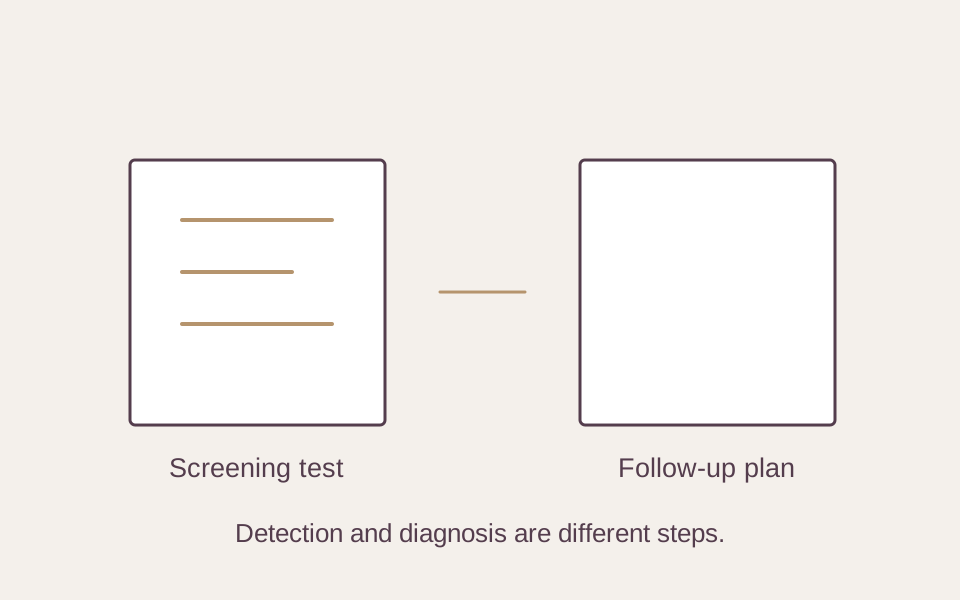
A screening test starts a pathway
Stool DNA testing can help eligible people enter colorectal-cancer screening, but its headline cancer sensitivity does not summarize the whole decision. Existing cancer, advanced precancerous lesions and the need for follow-up colonoscopy are different endpoints. A useful comparison keeps them separate and includes the chance of a positive result when the target condition is absent.
This article examines three primary accuracy studies rather than ranking tests by a single percentage. These studies compare test results with colonoscopic findings at a particular screening encounter. They cannot, by themselves, determine how many deaths a repeated screening program prevents. Participation, repeat testing and completion of diagnostic follow-up sit between an attractive test characteristic and a better clinical outcome.
What the original stool-DNA comparison showed
Imperiale and colleagues studied an earlier multitarget stool-DNA test in asymptomatic, average-risk people in 2014. Among 9,989 evaluable participants, 65 had cancer and 757 had advanced precancerous lesions on colonoscopy. Cancer sensitivity was 92.3% for stool DNA and 73.8% for the FIT used in that study. Advanced-precursor sensitivity was lower: 42.4% and 23.8%, respectively. [1]
The denominator matters. Sensitivity asks how many people with the condition have a positive result. It does not say that 92.3% of everyone receiving a positive stool-DNA result has cancer. The disease prevalence in the tested population and the frequency of false positives also shape what an individual positive result means.
BLUE-C tested a next-generation assay
The 2024 BLUE-C prospective study evaluated a newer stool-DNA assay in 20,176 participants undergoing screening colonoscopy. It reported 93.9% cancer sensitivity, 43.4% sensitivity for advanced precancerous lesions and 90.6% specificity among participants without advanced neoplasia. The contemporaneous FIT values were 67.3%, 23.3% and 94.8%, respectively. The study was funded by Exact Sciences. [2]
The newer assay detected more of the target lesions than that FIT at the tested thresholds, while producing more positive results among people without advanced neoplasia. That is a tradeoff, not a universally superior result. The figures also should not be pasted onto an older test generation or used as though every FIT product and threshold performs identically.
For the practical purchase implications, see the Cologuard Plus review. Keep the service features separate from the scientific result.
A blood draw changes collection, not the endpoint
Chung and colleagues evaluated a cell-free DNA blood test in the ECLIPSE study. Of 10,258 people in the clinical validation cohort, 7,861 were evaluable. Reported sensitivity was 83.1% for cancer and 13.2% for advanced precancerous lesions; specificity among participants without advanced neoplasia was 89.6%. Guardant Health funded this research. [3]
Blood collection may appeal to someone reluctant to collect stool, but ease of collection does not make cancer and precursor detection interchangeable. ECLIPSE and BLUE-C were separate studies with their own participants and methods. Their published figures are informative about each test; subtracting them does not create a randomized head-to-head comparison or establish which complete screening strategy a particular person should choose.
A positive result is an instruction to investigate
Current Cologuard labeling limits screening to eligible average-risk adults aged 45 and older and directs positive results to colonoscopy. It also states that negative results do not exclude cancer and that the tests do not replace diagnostic or surveillance colonoscopy in higher-risk people. [4]
These boundaries change the practical choice. A person who cannot currently access colonoscopy after a positive result has an unresolved part of the screening pathway. Someone with a relevant personal or family history may need a different starting point. Ordering a more convenient sample does not remove the need to establish the right risk group or to investigate symptoms appropriately.
Do not confuse a one-round study with a program
The studies cited here establish performance at an observed encounter. They do not directly compare every repeated testing schedule, each plan’s coverage, or the consequences of incomplete follow-up. A test that detects a greater fraction of cancers in one round can still create more false-positive investigations. A less burdensome collection method may improve participation, but that requires evidence about participation rather than an assumption. [1] [2] [3]
The distinction is useful beyond cancer screening. More findings are not automatically better prevention. Consider whether you can complete the recommended interval and the next clinical step, how results will reach the ordering professional, and whether a change in history would move you into another pathway. Those details help translate measured accuracy into an actual screening decision.
The distinction also matters when considering broader preventive blood panels; each measurement needs its own evidence and follow-up pathway.
Choose with both the target and the next step visible
An average-risk screening discussion should compare what each option looks for, what it misses, what a positive result requires and what a negative result leaves unresolved. Keep the exact assay and generation on the order. A headline that says only “cancer detection” leaves out precursor detection and specificity, two features that can materially change the experience of a screening program.
Cologuard Plus is one route into that discussion, not a substitute for it. The most useful result is one that can be interpreted and acted on within an appropriate care pathway. A convenient test that is completed and followed up may serve a person well; the evidence still needs to support the specific claim being made about it.
Sources
- Imperiale et al. (2014): multitarget stool DNA versus FIT (opens in a new tab)
- Imperiale et al. (2024): BLUE-C next-generation stool DNA study (opens in a new tab)
- Chung et al. (2024): ECLIPSE blood-based screening study (opens in a new tab)
- Cologuard: intended population and follow-up requirements (opens in a new tab)
Research describes groups and specific study conditions. Your medical history, symptoms and treatment decisions require advice from your own qualified clinician.