In this article

What to know
- A new AF diagnosis and a prevented stroke are different endpoints.
- The strongest applicability depends on the population and complete screening pathway.
- A short normal ECG does not exclude an intermittent rhythm.
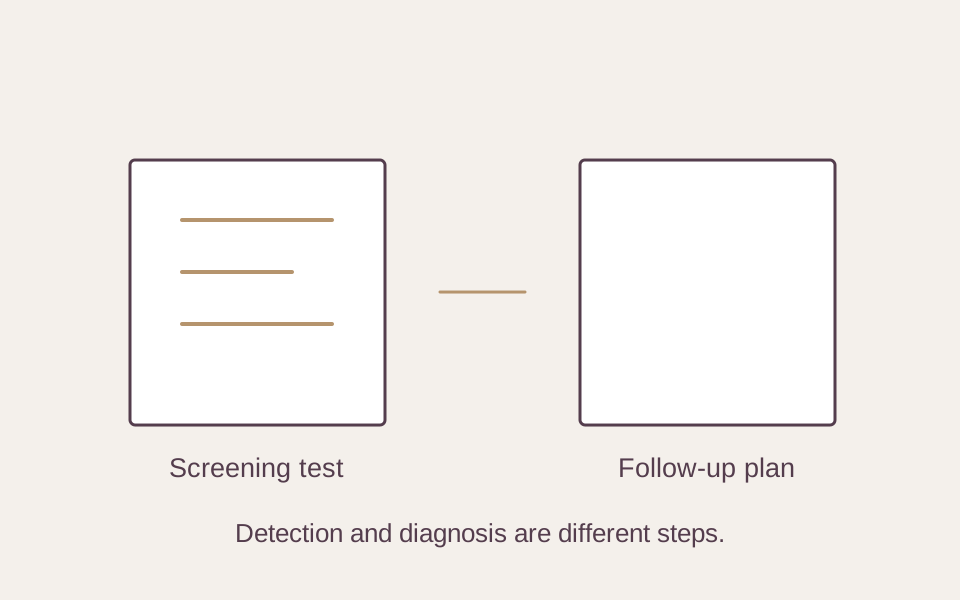
The key question comes after detection
A personal ECG can capture useful rhythm information. The harder question is whether systematically finding more atrial fibrillation improves outcomes for the person being screened. An accurate trace, a new diagnosis and a prevented stroke are successive achievements. Evidence for one should not silently stand in for evidence for all three.
This distinction does not make a short recording unhelpful. It makes the intended use important. Recording an event for a clinician to review, screening an older population and providing continuous surveillance are different tasks. The trials below tested specific programs, with selected participants and follow-up care. None establishes that every healthy adult benefits from purchasing a personal ECG device.
REHEARSE-AF primarily tested detection
The 2017 REHEARSE-AF trial studied 1,001 participants, with a mean age of 72.6 years, assigned to an AliveCor-based remote ECG strategy or routine care. Over 12 months, AF was diagnosed in 19 of 500 participants in the ECG group and five of 501 in routine care. Time to AF diagnosis was the primary endpoint. [1]
Those counts support greater detection in that program. The reported stroke, TIA or systemic-embolism events were six versus ten, with a confidence interval that did not establish a significant difference. It would be misleading to turn the larger diagnosis yield into a proven stroke reduction. It would also be misleading to apply the findings directly to a younger low-risk buyer with a different recording habit.
STROKESTOP evaluated an invitation and care pathway
STROKESTOP randomized Swedish residents aged 75–76 to an invitation for screening or a control group. Participants without known AF recorded intermittent ECGs for 14 days, and anticoagulation was offered when indicated within the study pathway. About 51% of eligible invitees participated. The trial therefore tested an invitation strategy, not simply ownership of a gadget. [2]
After a median 6.9 years, the combined primary endpoint occurred in 31.9% of the invitation group and 33.0% of controls: a difference of 1.1 percentage points. The endpoint included stroke, systemic embolism, bleeding requiring hospitalization and death. Its modest result should not be relabeled as an equally sized reduction in stroke alone or attributed to a particular consumer product.
For the practical purchase implications, see the KardiaMobile review. Keep the service features separate from the scientific result.
LOOP found much more AF without a clear primary benefit
The LOOP trial used implantable monitoring in 6,004 older adults with stroke risk factors. Median follow-up was 64.5 months. AF was diagnosed in 31.8% of monitored participants and 12.2% of controls. Anticoagulation was initiated more frequently as well. Yet stroke or systemic arterial embolism occurred in 4.5% versus 5.6%, with a hazard ratio of 0.80 and a 95% confidence interval of 0.61–1.05. [3]
That interval did not establish a statistically significant reduction in the primary outcome. Continuous implantable monitoring is not the same product as a finger-contact ECG, but the trial illustrates an important causal gap: increasing detection does not guarantee a proportionate improvement in the outcome that motivated screening. The burden and context of detected arrhythmia matter to subsequent clinical decisions.
A short trace answers a short observation window
A finger-contact device records while the person actively uses it. It cannot reconstruct every hour between recordings. KardiaMobile’s manufacturer describes a single-lead recording and states that it does not check for heart attack. Basic use does not require membership. [4]
Those facts explain its role more clearly than a broad heart-health claim. A saved trace can give a clinician something to review at a particular moment. A normal classification cannot exclude an intermittent rhythm outside that moment. Additional automated categories can change the app experience without demonstrating that a screening program produces better clinical outcomes. The commercial feature set and the clinical endpoint remain separate questions.
Treatment is part of the evidence
The screening trials included more than signal acquisition. Record interpretation, diagnostic confirmation and decisions about treatment connected detection to possible benefit. STROKESTOP’s endpoint also counted important harms and death, while LOOP reported bleeding alongside embolic outcomes. [2] [3] A consumer app should not be treated as an independent anticoagulation decision.
This is why comparison by sensor specifications alone is incomplete. A clinician needs the actual trace and context, and a person needs to know how results will be handled. The broader principle applies to blood-pressure cuffs too: a measurement becomes useful through a management pathway. A device can make observation easier without taking responsibility for the clinical decisions that follow.
The distinction also matters when considering home blood-pressure monitoring; each measurement needs its own evidence and follow-up pathway.
Match the purchase to an agreed use
A reasonable reason to buy a personal ECG is a specific recording task with an identified reviewer. The trial evidence is a weaker basis for telling every person to screen indefinitely. Keep age, baseline risk, recording intensity and the tested endpoint visible when interpreting a study. A positive automated label should lead to appropriate review rather than self-prescribed treatment.
Do not use repeated recordings to postpone assessment of concerning symptoms, and do not infer protection from a normal app result. The useful promise is modest and concrete: a convenient way to capture a short electrical record. Whether systematic screening prevents harm is a larger question, answered by programs and outcomes rather than the number of diagnoses on a dashboard.
Sources
Research describes groups and specific study conditions. Your medical history, symptoms and treatment decisions require advice from your own qualified clinician.