In this article
What to know
- Home readings can help confirm an office result before treatment.
- Trials tested monitoring linked to clinical management, not a cuff purchase alone.
- Fit, measurement technique and a usable record matter more than app scores.
The useful outcome is a better decision
Home blood-pressure monitoring has a clearer clinical purpose than many measurements sold under a longevity label. It can help establish whether a raised office reading persists outside the appointment, and it can inform treatment follow-up. The useful product is a dependable record connected to an appropriate clinical decision. A cuff in a drawer supplies neither.
This also changes how to evaluate a connected monitor. Automatic transfer may be worth paying for if it makes the record easier to maintain and share. It does not make the pressure itself more meaningful. Start with the clinical question, then choose the simplest reliable way to collect the information it requires.
An office result and a diagnosis are different steps
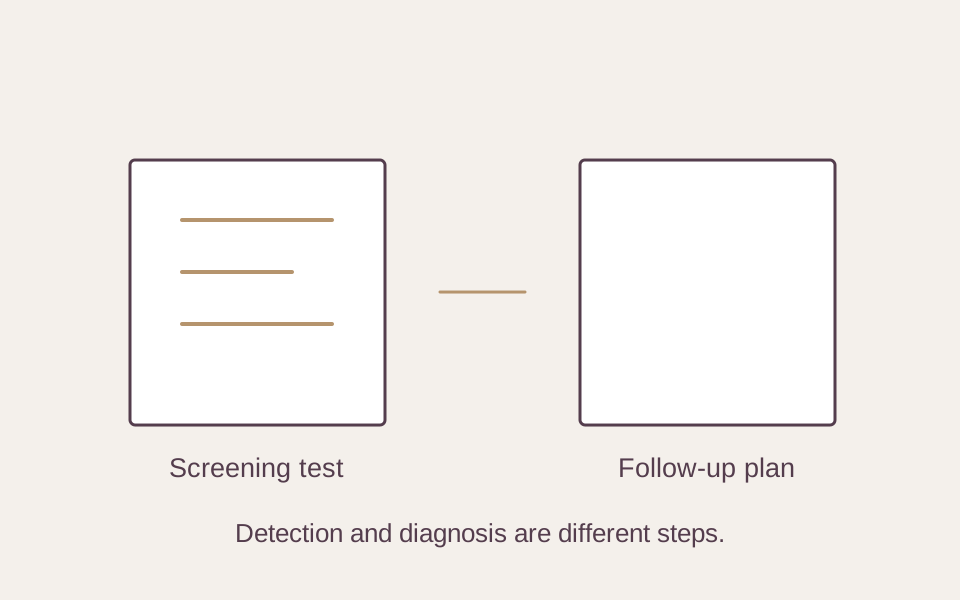
The USPSTF recommends screening adults without known hypertension with office measurements, followed by measurements outside the clinical setting to confirm a diagnosis before treatment. It identifies home monitoring and ambulatory monitoring as options. Ambulatory monitoring collects readings through ordinary activities and sleep; home monitoring samples selected moments. These methods should not be treated as interchangeable streams of identical information. [1]
For someone with an unexpected office result, the next step may therefore be a structured confirmation plan. Repeatedly checking until a reassuring number appears defeats that purpose. Agree on the schedule and how the results will be assessed before turning measurement into a daily ritual.
A related perspective: Preventive blood panels: when more tests change a decision.
What the medication-management trial tested
TASMINH4 randomized adults with poorly controlled hypertension in UK primary care to usual care, self-monitoring, or self-monitoring with telemonitoring. The home results informed medication titration. At 12 months, clinic systolic pressure was lower than usual care by an adjusted 3.5 mm Hg with self-monitoring and 4.7 mm Hg with telemonitoring. The respective confidence intervals were −5.8 to −1.2 and −7.0 to −2.4 mm Hg. [2]
This is evidence for monitoring embedded in care. It does not establish that purchasing any app-linked cuff lowers blood pressure by the same amount. It also does not establish that telemonitoring is necessary for every reader. The intervention included a route from information to treatment decisions.
Digital support can help, within its tested setting
HOME BP enrolled 622 people with treated but poorly controlled hypertension and internet access across 76 UK general practices. Its intervention combined home readings, feedback to patients and professionals, and guided management. At one year, the adjusted systolic-pressure difference favored the intervention by 3.4 mm Hg, with a 95% confidence interval from −6.1 to −0.8. [3]
The trial supports a practical proposition: a well-organized feedback system can improve control. It cannot tell an untreated reader what their personal target should be, or whether an unrelated consumer dashboard reproduces the program. The authors subsequently corrected baseline-table entries; the correction concerns demographic data rather than a newly reported treatment effect. [4]
Validation belongs to the exact monitor
A 2022 study evaluated Withings BPM Connect against the AAMI/ESH/ISO universal standard in the general population and reported that it met the protocol's accuracy requirements. The study disclosed support from Withings and other organizations. That is relevant device-specific measurement evidence, while leaving other questions—such as the value of a subscription—unanswered. [5]
A validation result is not a promise that every home reading will match a clinic reading. Nor can it be transferred automatically to another model from the same manufacturer. Read the cuff's supported arm range and the product's conditions of use. An attractive device is a poor choice if its cuff does not fit.
Give the measurement consistent conditions
The USPSTF describes upper-arm measurements using a validated, accurate device, with the person seated after five minutes of rest. [1] Your clinician can set an appropriate recording schedule and explain which readings require contact. Keep the original values available, with enough timing information to make the series understandable.
Treat a color band as a display aid. It cannot account for your entire clinical history, and a consumer should not adjust medication merely to improve an app's presentation. When values look inconsistent, review fit, technique and the agreed plan rather than selecting the number that feels most believable.
Pay for a record you will actually use
A connected cuff makes sense when it removes a real obstacle to completing a useful record. A simpler validated monitor may be enough if you reliably write down readings. The comparison should include setup, display readability, sharing options and ongoing charges for the exact features you need.
Blood pressure and a broad laboratory panel answer different questions. A testing membership does not replace confirmation of a raised pressure, while a home cuff cannot explain an abnormal laboratory result. Keep each measurement attached to its own decision. That is a more useful form of prevention than collecting an increasingly elaborate dashboard.
To connect the evidence with a purchase decision, read Read the BPM Connect review.
Sources
- USPSTF: hypertension screening and confirmation (opens in a new tab)
- McManus et al. (2018): TASMINH4 randomized trial (opens in a new tab)
- McManus et al. (2021): HOME BP randomized trial (opens in a new tab)
- BMJ (2022): HOME BP baseline-table correction (opens in a new tab)
- Topouchian et al. (2022): BPM Connect validation study (opens in a new tab)
Research describes groups and specific study conditions. Your medical history, symptoms and treatment decisions require advice from your own qualified clinician.