In this article
What to know
- Pigmentation-related performance concerns vary by device and conditions.
- Race categories in hospital records are not direct skin-tone measurements.
- Do not use a race-based correction or let a reassuring number override important symptoms.
An oxygen estimate is not a direct blood sample
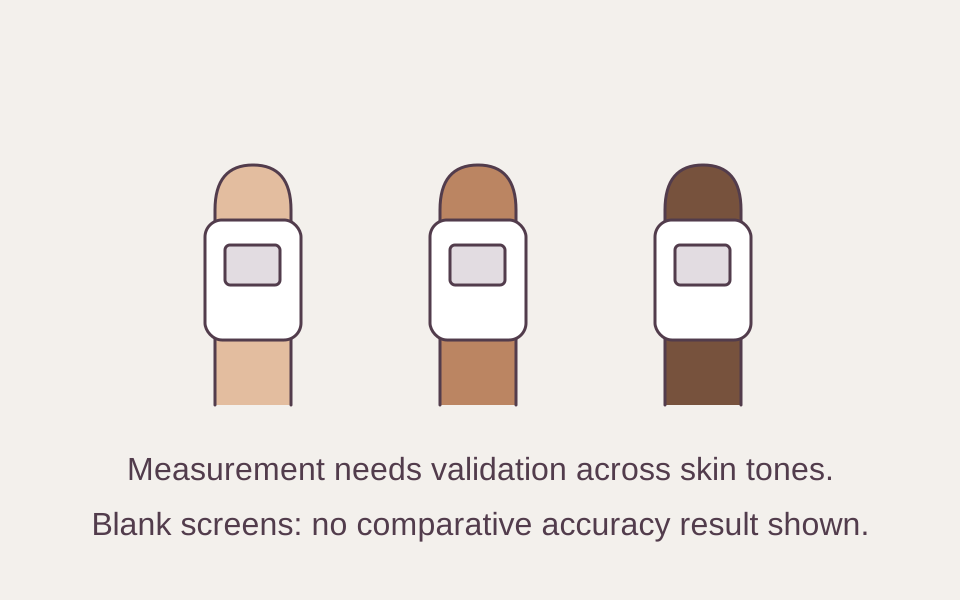
A pulse oximeter estimates oxygen saturation through an optical signal. A reassuring display can be useful, but it is not an assurance that every relevant problem has been excluded. Research has identified circumstances in which a displayed value overestimates arterial oxygen saturation, including differences associated with pigmentation or race in some settings. [1] [2] [3] The direction of the error matters: a value that looks acceptable can conceal lower oxygenation.
The practical response is to understand the limits rather than invent a correction. A person should not subtract a fixed number because of their racial identity, compare two unvalidated devices and assume the average is correct, or delay needed care because a consumer screen looks normal. The evidence concerns devices, populations, conditions and reference measurements; those details belong beside the headline finding.
A controlled experiment tested pigmentation directly
Bickler, Feiner and Severinghaus studied 11 volunteers with darkly pigmented skin and 10 with light pigmentation while controlling arterial oxygen levels and comparing three finger oximeters against an arterial reference. At oxygen saturation between 60% and 70%, the mean overestimate across devices was 3.56 percentage points in the darkly pigmented group versus 0.37 in the light group. Effects varied by device and saturation range. [1]
This was a small laboratory experiment, not a study of every current ring, watch or fingertip product. The very low oxygen range also should not be treated as the usual condition of a healthy person checking a device at home. Its contribution is specific: it demonstrates that optical performance can differ with pigmentation under controlled conditions. It does not establish one universal error size that can be transferred to a different model or individual.
Hospital records showed why a missed low reading matters
Sjoding and colleagues compared paired pulse-oximeter and arterial measurements in hospitalized patients identified as Black or White. They examined occult hypoxemia: an arterial saturation below 88% despite a pulse-oximeter reading between 92% and 96%. The study found a higher frequency among Black patients in both its Michigan and multicenter cohorts. [2] That is an important clinical signal even though racial categories are not direct measurements of skin pigmentation.
The distinction limits the inference. Hospital patients may differ in illness, circulation, device use and other factors; an observational comparison cannot isolate pigmentation as the only explanation for every difference. It also does not estimate the error of a particular consumer product. Still, a measurement that more often misses an important low value can affect decisions. The absence of a warning on the screen is not the same as the absence of a problem.
Not every study found the same pattern
An earlier emergency-department study by Adler and colleagues obtained oxygen-saturation data from 284 patients, grouping pigmentation with standardized color swatches. It did not find a significant difference in average bias between the three pigmentation groups. Reports of suboptimal function were more common in the darkest group, but signal failure was rare. [3] This is a useful counterpoint rather than a reason to erase the later findings.
Different populations, saturation distributions and equipment can produce different estimates. A study containing mostly reassuring oxygen levels may answer a different question from an experiment deliberately examining substantial desaturation. The responsible conclusion preserves that variation. We should neither claim that every device is always wrong for darker skin nor assume that a favorable average in one setting guarantees reliable detection of a low value in another.
Average accuracy does not describe every reading
Consider a device that is close to a reference for many ordinary readings but overestimates in the situations that matter most. Its overall average can look acceptable while a subgroup or a low-oxygen range remains poorly served. This is a statistical reason to ask for performance across relevant conditions rather than rely on a single accuracy phrase. It does not require assuming bad intent by a manufacturer or rejecting all optical monitoring.
For the buyer, the relevant evidence should match the actual model and intended use. A validation of a hospital sensor cannot automatically establish the performance of a wellness ring. A regulatory clearance for one use also should not be stretched into proof of every advertising claim. Keep the measurement, the population and the decision together before deciding whether a number is reliable enough for the task being proposed.
Other sources of error remain important
The FDA lists poor circulation, skin pigmentation, skin thickness and temperature, tobacco use and nail polish among factors that can affect readings. It also distinguishes medical-purpose devices from general wellness products. [4] These are overlapping practical limits, not competing explanations where acknowledging one removes the others. A technically difficult signal and a pigmentation-related performance concern can both matter for the same person.
Follow the instructions supplied for the actual device and the advice of the clinician who requested monitoring. Do not change prescribed oxygen or medication based on a consumer interpretation of a graph. If symptoms are concerning or worsening, seek medical assessment rather than repeatedly repositioning the sensor until a more reassuring number appears. A better-looking display after several attempts does not explain why the earlier values or symptoms occurred.
An overnight oxygen record is not a complete apnea pathway; compare the evidence on home sleep apnea testing.
Use the record to support a conversation
A time-stamped record can help show when a concern occurred, but it does not have to become a personal diagnosis. Preserve the model name, the circumstances and the full report when discussing it with a clinician. That information is more useful than an isolated screenshot with no context. A repeated pattern may justify a different examination without proving what that examination will find.
When comparing products, start with intended use and the evidence for that model, then consider fit, recording and cost. A subscription-free wellness ring may be a convenient recorder while still being the wrong tool for clinical decision-making. The purpose of recognizing measurement limits is to avoid false certainty. A number can inform the next step, provided it is not allowed to overrule symptoms, replace appropriate assessment or acquire a precision that the underlying evidence does not support.
For a consumer product whose own label defines a wellness role, see our Wellue O2Ring review.
Sources
- Bickler et al. (2005): controlled hypoxia experiment and pigmentation (opens in a new tab)
- Sjoding et al. (2020): occult hypoxemia in hospital cohorts (opens in a new tab)
- Adler et al. (1998): emergency-department pigmentation study (opens in a new tab)
- FDA: pulse oximeter purpose and limitations (opens in a new tab)
Research describes groups and specific study conditions. Your medical history, symptoms and treatment decisions require advice from your own qualified clinician.