In this article
What to know
- Trials evaluated assessment and treatment pathways, not an isolated gadget.
- Patient selection limits how widely trial results apply.
- A negative or inadequate home result may need laboratory follow-up.
The evidence belongs to a pathway
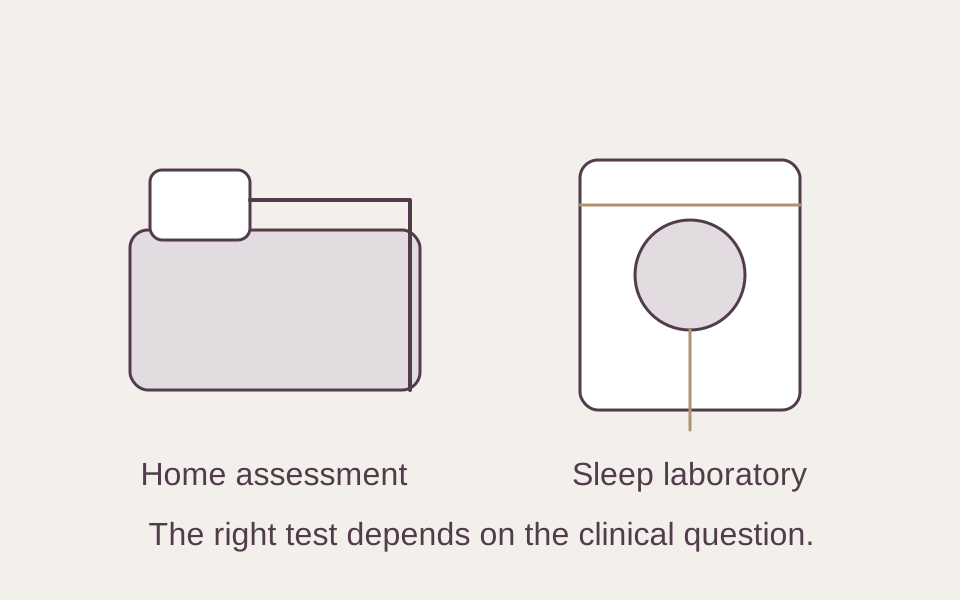
Home testing can be a useful route into obstructive sleep apnea care for an appropriately selected adult. The strongest evidence is not simply that a portable device records a signal. Randomized studies compare a process that includes assessment, testing, pressure selection and treatment follow-up with a laboratory-based process. [1] [2] [3] Removing those other steps changes the intervention being discussed, even if the sensor appears similar.
This matters when shopping online. A kit price, an app screenshot and a promise of convenience describe only part of the decision. The relevant service must also explain who determines suitability, how an uninterpretable result is handled and how recommended treatment is arranged. A technically successful night at home should be the start of an understandable clinical result, rather than a file of measurements that the buyer is left to interpret alone.
HomePAP tested selected symptomatic referrals
The 2012 HomePAP study randomized 373 adults referred to seven accredited sleep centers. Participants had a high clinical probability of moderate to severe obstructive sleep apnea and an Epworth Sleepiness Scale score of at least 12. The home arm used level-three testing followed by a week of auto-adjusting PAP; the comparator used laboratory studies and titration. Roughly half in each arm met the apnea-hypopnea threshold to continue. [1]
At three months, average nightly PAP use was 4.7 hours in the home group versus 3.7 hours in the laboratory group. Acceptance, time to treatment and improvement in sleepiness did not differ between arms. [1] This is evidence for a supported approach among selected referrals. It is not a demonstration that any home gadget is suitable for any person who feels tired, or that the diagnostic recording alone caused the adherence difference.
Another randomized study focused on function and adherence
Kuna and colleagues enrolled 296 veterans with suspected obstructive sleep apnea, comparing home testing followed by automatic pressure adjustment with standard laboratory evaluation. People diagnosed with apnea received CPAP for three months. Functional Outcomes of Sleep Questionnaire scores improved by 1.74 points in the home arm and 1.85 in the laboratory arm; the prespecified analysis supported noninferiority. [2]
Average daily use was 3.5 versus 2.9 hours, a difference that was not conventionally statistically significant in the reported comparison. [2] Noninferiority has a specific meaning: the study tested whether outcomes stayed within a prespecified acceptable margin, not whether the two methods were identical in every respect. Its veteran population and organized treatment process should remain visible when applying the result to a commercial service with different support or patient selection.
The early ambulatory trial was deliberately selective
Mulgrew and colleagues studied 68 patients with a high pretest probability of moderate to severe apnea in a tertiary sleep program. Their ambulatory approach combined a clinical selection process, overnight oximetry and auto-adjusting treatment, rather than relying on a generic wellness record. At three months, residual apnea on treatment and several symptom or quality-of-life outcomes were similar to the laboratory pathway. [3]
The small, selected population is a limitation and part of the explanation for why the strategy worked. A useful interpretation keeps both facts. It is inappropriate to turn a carefully selected pathway into a universal rule that laboratory testing is unnecessary. It is equally inappropriate to dismiss all home approaches because they collect fewer signals. The correct question is whether the approach answers this person’s diagnostic question with a workable plan for uncertainty.
A negative home result may leave the question open
The American Academy of Sleep Medicine guideline recommends laboratory polysomnography after a single home test that is negative, inconclusive or technically inadequate when evaluating suspected apnea. It also recommends laboratory testing rather than home testing in several complex clinical situations, including significant cardiorespiratory disease and suspected sleep-related hypoventilation. [4] These are eligibility and follow-up decisions, not a suggestion that a buyer should diagnose their own suitability from a checklist.
A negative result can be falsely reassuring if the underlying concern remains strong. Technical problems can also look like an unremarkable night unless the recording is reviewed properly. If symptoms persist, take the result back to the clinician instead of repeatedly purchasing consumer monitors. The next step may be another kind of examination, not another attempt to collect the same limited signals under the same assumptions.
The number needs its recording context
The apnea-hypopnea index summarizes events per hour of sleep, while some home approaches use a recording-based respiratory event index or device-specific estimation. [4] The denominator matters: time recorded and time actually asleep need not be identical. This is one reason two numbers from different methods should not be compared as if they came from an interchangeable measurement process.
For a patient, the useful discussion includes whether the recording was technically adequate, how the reported index was calculated and whether the clinical history fits the result. Do not build a personal severity label from an isolated oxygen dip or a wearable’s stage estimate. Those signals may prompt a question, but the clinical interpretation draws on more than the most dramatic moment in a graph. Preserve the complete report so another clinician can understand the method used.
An ordinary wearable answers a different question, as explained in the distinction between sleep tracking and clinical assessment.
Separate diagnosis, equipment and ongoing support
A home-test service can reduce the practical burden of arranging assessment without making later treatment free or effortless. Compare those decisions separately: the assessment package, the prescribed equipment if needed, and access to support during use. This is a purchasing implication of the trials’ complete pathways, not a financial result those trials established for every contemporary seller.
Before buying, confirm the interpreting clinician, unsuitable-patient policy, failed-recording process and how results are shared. Afterward, discuss the report and preserve any prescription so care can be compared or transferred appropriately. The important lesson is that home and laboratory approaches can both be useful when matched to the clinical question. Convenience is a valuable feature of care, provided it remains attached to suitable selection, reliable interpretation and a plan for the result that does not settle the question.
For the current commercial test package and separate treatment costs, read the Lofta home sleep test review.
Sources
- Rosen et al. (2012): HomePAP randomized pathway trial (opens in a new tab)
- Kuna et al. (2011): ambulatory evaluation noninferiority trial (opens in a new tab)
- Mulgrew et al. (2007): randomized ambulatory diagnosis and initial management (opens in a new tab)
- AASM (2017): diagnostic testing guideline (opens in a new tab)
Research describes groups and specific study conditions. Your medical history, symptoms and treatment decisions require advice from your own qualified clinician.