In this article
What to know
- Collection validation, screening uptake and clinical outcomes are different endpoints.
- Randomized outreach trials support direct mailing as a way to increase participation.
- An abnormal HPV result requires an appropriate follow-up pathway.
Three questions inside one screening promise
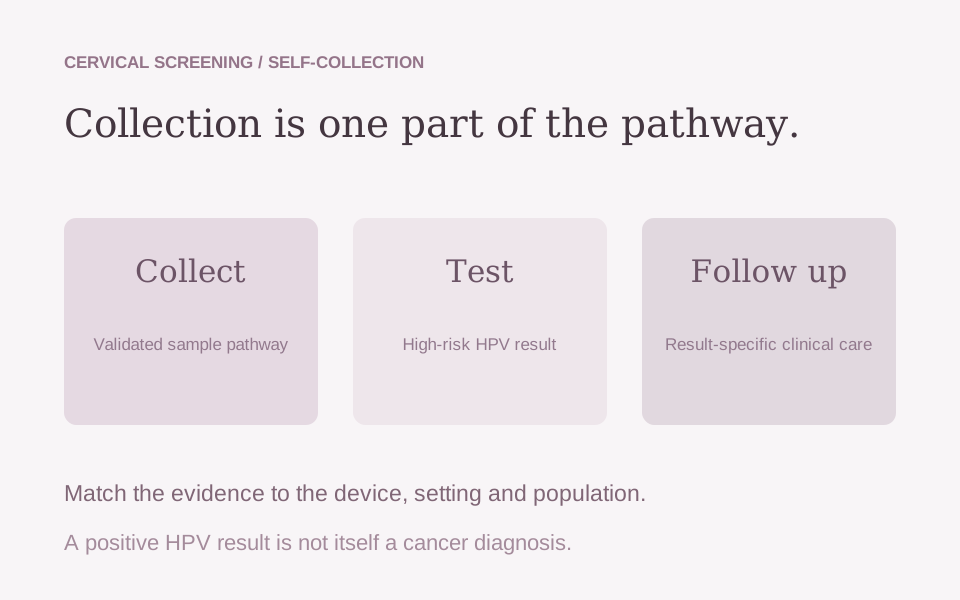
HPV self-collection can make cervical screening easier to complete, but a collection device and a prevention program answer different questions. The first asks whether a sample can support an appropriate laboratory result. The second asks whether more people get screened. The third asks whether abnormal results lead to the evaluation and treatment that screening is intended to make possible. A strong answer to the first question does not automatically settle the other two. This distinction matters when a familiar examination becomes a kit delivered to the door. [1] [2] [3]
The practical attraction is substantial without attaching an exaggerated outcome to it. Someone who postpones a speculum examination may find private collection more acceptable. Someone already receiving timely screening may gain convenience rather than a larger preventive benefit. These are different starting points, even if both people return an adequate sample. A useful assessment therefore keeps the collection method, the person’s screening history and the follow-up pathway together. A kit that remains unopened cannot improve participation; a positive result without an accessible next appointment leaves the preventive pathway unfinished.
A vaginal sample is not a home cancer diagnosis
The FDA’s May 2025 Teal Wand authorization concerns a prescription device that collects and transports vaginal specimens for an FDA-approved HPV molecular assay with which the device has been validated. The collection device can be used at home or another private setting, with dry transport in an empty vial. That is a specific device-and-assay arrangement. It does not establish that every swab, transport medium or laboratory test can be substituted without affecting performance. The authorization also identifies collection quality and compliance with shipping and storage instructions as material limits. [4]
The result belongs to a screening pathway. Detecting high-risk HPV is different from identifying a visible lesion or confirming cancer in tissue. Likewise, a negative screening result is not an explanation for symptoms. The everyday phrase “home cervical cancer test” can obscure these distinctions by compressing several clinical steps into one purchase. The more useful description is home collection for HPV screening, followed by interpretation and any indicated care. Convenience changes where the sample is obtained; it does not make every subsequent question answerable from that sample alone.
The distinction between screening and confirmation also shapes How another home screening pathway handles a positive result.
SELF-CERV tests the collection method
The 2025 SELF-CERV study used a nonrandomized method-comparison design, analyzing 599 paired samples. Collection took place in a simulated home setting so the clinician specimen could be obtained at the same visit. Participants supplied a self-collected vaginal specimen and a clinician-collected specimen, allowing the investigators to compare methods within the study population. Its central contribution is validation of the specified collection approach against clinician collection for high-risk HPV screening. This design is well suited to the question of whether moving collection into the participant’s hands compromises the intended measurement. It is not a randomized comparison of lifetime cancer outcomes between home screening and office care. [1]
A paired comparison has a useful strength: the two methods are evaluated in the same people rather than in unrelated populations. It also has a boundary. Agreement between methods says little by itself about who will order a kit outside a study, whether shipping will happen promptly or how an abnormal result will be managed. A headline percentage can distract from these separate tasks. Before translating a validation result into a broad promise, identify the actual assay, intended specimen, study setting and endpoint. The assay result is one component of a larger decision.
For the specific commercial service, compare Teal Wand pricing, virtual visits and refund boundary.
HOME and STEP ask whether access changes participation
The HOME randomized trial included 19,851 participants in its intention-to-treat analysis and compared usual care with usual care plus mailed HPV self-sampling kits in an integrated US health system. Screening uptake increased with the mailed-kit approach, but the study did not establish a corresponding significant increase in detection and treatment of cervical precancer. This is an instructive separation: a delivery intervention can improve participation while leaving a rarer downstream endpoint uncertain. It would be inaccurate to translate the uptake finding directly into a measured reduction in cancer deaths. [2]
The later STEP randomized trial included 31,355 individuals and separated groups by screening history. Among those overdue, screening occurred in 36% after a direct-mail kit versus 19% with education alone. Among those due, the corresponding figures were 62% and 48%. An opt-in offer was less effective than direct mailing in the relevant comparisons. These results describe an outreach strategy, not the performance of every commercial kit. Requiring a person to notice an invitation, request a kit and complete checkout can introduce friction that direct mailing removes. [3]
Follow-up determines what a positive result can change
These studies make an operational point that is easy to miss in a product comparison. Participation has several stages: accepting the invitation, obtaining a usable sample, receiving a result and completing any recommended next step. A program can perform well at one stage and lose people at the next. The relevant denominator changes at each transition. Counting kits ordered is therefore a weaker description of completed screening than counting appropriate tests completed and results acted upon. Similarly, a reassuring satisfaction survey does not measure treatment completion.
This is why the home route should be judged alongside the care that surrounds it. A person with a prior abnormal result may need a different pathway from someone returning to routine screening after a long gap. Eligibility and screening timing should come from applicable clinical guidance and the individual history, rather than a retailer’s general age range. Preserve the actual report and the recommended follow-up plan. A change in collection setting should not sever the connection with a clinician or clinic able to carry the next step forward.
Choose a screening pathway before choosing a kit
The evidence supports a measured conclusion: validated self-collection can expand the ways people participate in HPV screening, and direct outreach can improve uptake. It does not turn screening into a universal mail-order answer to every cervical health concern. The strongest purchase rationale is a concrete barrier to completing an appropriate test, paired with a clear route for interpreting and acting on the result. This is more specific than seeking another preventive score, and more useful than treating every new collection technology as a reason to test more often.
Cost comparisons should preserve that scope. A one-time collection-and-laboratory service is different from an annual panel membership, and neither should be judged by the number of results produced. Write down the exact included services, the circumstances that require outside care and the point after which cancellation changes. If the home route solves a real access problem, that may be sufficient value. Its credibility comes from matching the validated method to the appropriate person and keeping follow-up visible, rather than promising certainty from a specimen sent through the mail.
To compare a quoted commitment, use Model a one-time screening payment separately from recurring fees.
Sources
- SELF-CERV: original nonrandomized method-comparison trial (opens in a new tab)
- HOME: randomized mailed HPV kits versus usual care (opens in a new tab)
- STEP: randomized direct-mail and opt-in screening strategies (opens in a new tab)
- FDA: Teal Wand De Novo authorization and validated-use limits (opens in a new tab)
Research describes groups and specific study conditions. Your medical history, symptoms and treatment decisions require advice from your own qualified clinician.