In this article
What to know
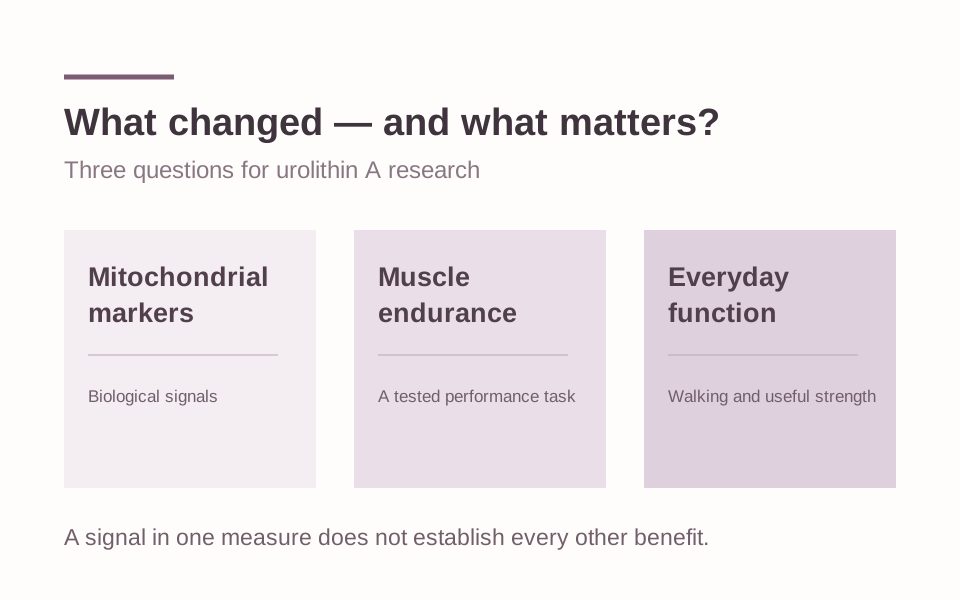
- Mitochondrial biomarkers, repeated muscle contractions and walking performance answer different questions.
- Two functional trials reported favorable secondary findings while missing their primary performance outcomes.
- These studies do not establish preserved independence or a longer healthy lifespan.
Begin with the task a person can actually do
Urolithin A has a more developed human evidence base than a mechanism-only supplement story, but its muscle-function results need careful boundaries. Selected measures improved in randomized trials, while the principal walking or power outcomes did not show a significant advantage over placebo. [2] [3] The useful conclusion is neither that every benefit is established nor that every favorable result should be discarded. The endpoint determines what the finding can support.
Imagine two different observations: a muscle completes more contractions in a laboratory test, and a person walks farther during a timed assessment. Both can matter, but one does not automatically establish the other. Neither, by itself, demonstrates fewer falls, preserved independent living or extra years of health. A clear explanation keeps the test in its original units and asks how closely it matches the reader’s actual goal. That is particularly important when the product is marketed through the broad language of cellular renewal.
For why a muscle measurement needs an outcome attached, read grip strength and physical function.
The first human study tested exposure and biomarkers
Andreux and colleagues reported an early human trial in healthy, sedentary older individuals, using single doses and repeated dosing over four weeks. Safety was the primary outcome. The authors reported a favorable short-term safety profile and detectable exposure; at 500 and 1,000 milligrams, repeated dosing changed plasma acylcarnitines and skeletal-muscle mitochondrial gene expression. Those biomarker findings were secondary outcomes. [1]
This is a meaningful developmental step. An orally consumed ingredient needs to reach the body before a proposed biological action becomes relevant. Yet reaching circulation and changing a molecular pattern do not answer whether someone can carry shopping more comfortably or remain mobile for longer. The early study provides a reason to investigate those next questions. It does not allow the final clinical benefit to be inserted into the result simply because the biological explanation is appealing.
The older-adult trial did not establish a walking advantage
Liu and colleagues randomized 66 adults aged 65–90 to 1,000 milligrams daily or placebo for four months. The six-minute walk and maximal muscle ATP-production endpoints did not show significant between-group advantages. Walking distance increased by an average of 60.8 meters with urolithin A and 42.5 meters with placebo. A secondary contraction-endurance advantage appeared at two months; at four months, improvement in the placebo group meant the treatment difference was no longer significant. [2]
The placebo improvement explains why a before-and-after number is insufficient. Reporting only the larger walking increase would make the intervention look more decisive than the randomized comparison permits. The endurance result also needs its time point attached. A favorable interim assessment can identify a question worth studying without establishing a sustained advantage at the trial’s end. These distinctions preserve useful information instead of collapsing the study into a single favorable headline.
A second trial found strength signals, but missed peak power
The middle-aged ATLAS study randomized 88 untrained, overweight adults to placebo, 500 milligrams or 1,000 milligrams daily for four months. The report described improvements in hamstring strength at both doses, but peak power output, the primary endpoint, did not improve significantly. The abstract also discussed aerobic and walking findings; the figure description identifies the peak-oxygen-consumption comparison with placebo as not statistically significant. [3]
That combination deserves a precise reading. A strength result in one tested muscle is not a general percentage improvement in everything a person can lift. Power, maximum force and resistance to fatigue are related but distinct capabilities. Treating them as synonyms allows a marketing claim to grow without any new experiment. Conversely, the missed primary outcome does not erase the measured strength signal. It changes the level of confidence appropriate for a broad performance claim and makes further confirmation valuable.
For a separate intervention question about improving function, consider strength-training evidence in older adults.
The evidence needs replication as well as a mechanism
The older-adult study was supported by Amazentis, with sponsor involvement in design, analysis and publication; the ATLAS declaration also identifies Amazentis sponsorship and employee or advisory relationships among authors. [2] [3] Commercial involvement does not invalidate a randomized comparison. It does make independent replication a particularly useful next step before treating the existing findings as a settled consumer promise.
More fundamentally, a reader should decide which result would justify action. Someone concerned about a declining ability to rise from a chair is asking a different question from someone curious about a mitochondrial biomarker. A study can be well designed for the second question and still provide an incomplete answer to the first. The strongest next trial would keep the relevant population and functional outcome explicit, rather than asking a large collection of favorable laboratory results to stand in for daily life.
Use the research to narrow the purchase decision
These trials describe specific doses, formulations, participants and follow-up periods. They are not personal dosing instructions, and they do not establish that a newer gummy, a different brand or a supplement combination reproduces every reported effect. Matching an ingredient name is only the start of an applicability check. Product composition, the intended outcome and the evidence supporting that outcome should remain connected.
For a reader with a new or worsening functional difficulty, the first useful step is an appropriate assessment of the difficulty. Buying a supplement should not become a substitute for understanding why the task has become harder. For someone already considering an optional supplement, define the goal before purchase and compare the cost with the practical support that goal otherwise needs. A vague plan to improve cellular health is difficult to evaluate because almost any later change can be interpreted as success.
Keep ordinary training and activity visible in the discussion. The existence of a supplement trial without an added exercise program does not establish that exercise is unnecessary, or that the supplement is the better use of a limited budget. Our strength and mobility coverage asks separate intervention questions with outcomes relevant to function. Urolithin A remains interesting because the human studies measured more than absorption. The purchasing decision becomes more defensible when those findings stay specific, rather than being translated into a promise of broadly renewed muscles or a longer healthy life.
For the formulation and purchasing decision, read our Timeline Mitopure Gummies review.
For research that asked directly about mobility disability, see the LIFE trial’s mobility outcome.
Sources
Research describes groups and specific study conditions. Your medical history, symptoms and treatment decisions require advice from your own qualified clinician.