In this article
What to know
- Heart-rate agreement varies by device, activity and population.
- Validation of beat timing does not validate every derived HRV or recovery score.
- The receiving app and recording workflow are part of the measurement.
An accurate pulse is a measurement, not a training plan
A chest strap can improve the quality of exercise heart-rate information in some settings, but the useful claim is narrower than “better fitness.” Validation asks whether a device agrees with a reference under specified conditions. It does not establish that wearing it improves health, that a particular zone is appropriate, or that every derived training score is valid.
This matters when the number guides effort. A device that is adequate for an easy activity log may not be adequate for a protocol where small differences influence decisions. The right comparison begins with the person, exercise and required output. Three primary studies show why a general claim that a brand measures heart rate accurately leaves too much unspecified.
Activity changed agreement in healthy volunteers
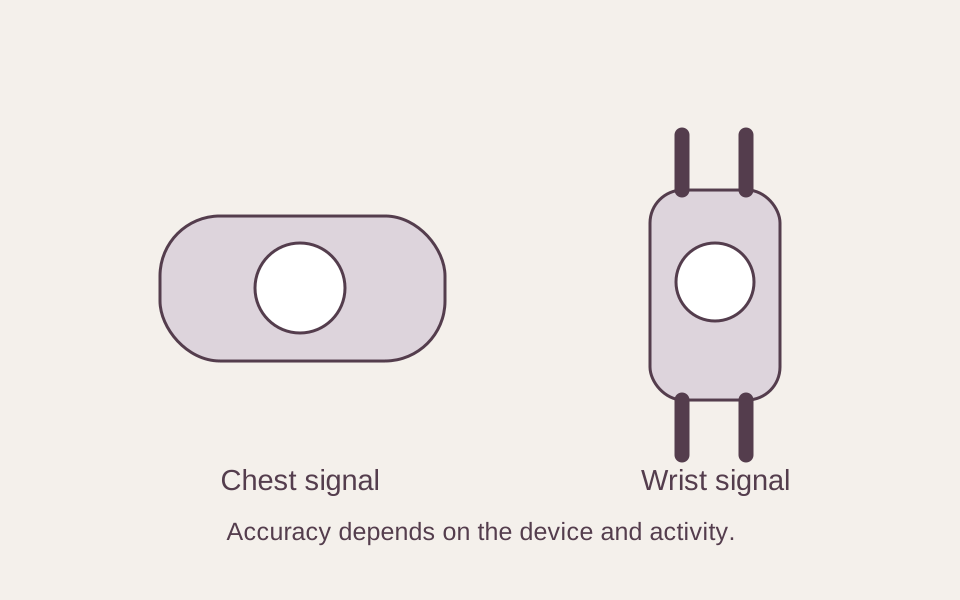
Gillinov and colleagues studied 50 healthy adults, averaging 38 years of age, during treadmill, stationary-cycle and elliptical exercise. They compared ECG with a Polar H7 chest sensor and several then-current optical devices. The chest sensor showed the strongest overall agreement with ECG, with a concordance coefficient of 0.996. Optical-device performance varied by activity, with particularly difficult results during elliptical exercise with moving arm levers. [1]
Those findings support an activity-specific judgment. They do not establish that every optical tracker fails or that an older model’s numerical result applies to a current watch. The practical lesson is to seek evidence for the activity you do. A device validated mostly during steady treadmill exercise may leave questions about another movement pattern or rapidly changing effort.
Cardiac rehabilitation is a different population
Etiwy and colleagues assessed 80 adults in phase II or III cardiac rehabilitation. Participants wore standard ECG leads, a Polar H7 chest sensor and two randomly assigned wrist devices during treadmill or stationary-cycle exercise. Across the studied conditions, the chest sensor showed closer agreement with ECG than the tested optical devices. The investigators reported variation across devices and exercise settings. [2]
This is useful evidence in a population that differs from young healthy volunteers. It does not prove that unsupervised exercise based on a consumer reading is safe. The study evaluated measurement agreement during a rehabilitation session, not the safety of replacing a rehabilitation program. A person’s exercise limits still need to come from the appropriate clinical and training context.
For the practical purchase implications, see the Polar H10 review. Keep the service features separate from the scientific result.
H10-specific work separates simple and complex outputs
A 2022 study compared Polar H10 with ECG in 25 participants before, during and after an exhaustive cycling ramp. Heart rate and RR intervals showed strong agreement and small bias. The nonlinear HRV measure DFA a1 showed wider disagreement, especially at higher intensities. [3]
That split is informative. A device can capture beat timing well without every mathematical summary built from those beats performing equally well. It is inappropriate to use good heart-rate agreement as validation for an unrelated readiness algorithm, an app’s threshold recommendation or a claimed biological-age change. Each step from signal to score introduces another question that needs its own evidence.
The exact receiving workflow matters
A chest sensor sends information to a receiving system. Polar documents Bluetooth, ANT+ and GymLink support for H10, but the app or equipment receiving the signal determines what gets displayed, saved and calculated. [4] A compatible connection does not mean all applications expose the same data or use the same analytical method.
Start with the output you need. Live heart rate on a bike console, a saved activity summary and an RR-interval file are different requirements. Before purchasing a sensor or subscription, check whether the complete combination supports that requirement. This is a practical interpretation of measurement evidence: a good sensor cannot rescue a workflow that discards the information your intended analysis depends on.
Precision should change a real decision
The cited validation studies compare measurements, rather than randomizing people to a device and measuring long-term health benefit. [1] [2] [3] A more accurate record can be useful, but it still needs a purpose. If your current device already supports the decision you make during comfortable walking, a chest strap may add inconvenience with little practical gain.
If heart-rate targets matter to a structured plan, the case for a more suitable sensor can be stronger. That does not mean chasing every fluctuation. Interpret readings alongside the activity and your circumstances, and follow an appropriate plan for symptoms or unexpected values. Do not let a normal displayed number override a reason to stop and seek assessment. The display is an observation, not permission.
The distinction also matters when considering VO2 max and long-term risk; each measurement needs its own evidence and follow-up pathway.
Choose the smallest setup that answers the question
Compare the exact model, studied activity, population and output before accepting an accuracy claim. Older H7 and wrist-device studies explain the measurement problem, while the H10 study provides more direct evidence for that particular sensor. They should not be merged into a permanent accuracy ranking of all current products.
For a buyer, the practical sequence is straightforward: identify the information gap, verify the receiving workflow, then decide whether the chest strap’s fit and care requirements are worth the benefit. For a reader interpreting research, keep exercise capacity, heart-rate measurement and mortality risk separate. A better signal can support an existing decision without establishing a new health outcome on its own.
Sources
- Gillinov et al. (2017): devices during different aerobic activities (opens in a new tab)
- Etiwy et al. (2019): wearables in cardiac rehabilitation (opens in a new tab)
- Schaffarczyk et al. (2022): H10 versus ECG at rest and exercise (opens in a new tab)
- Polar: H10 connection and setup documentation (opens in a new tab)
Research describes groups and specific study conditions. Your medical history, symptoms and treatment decisions require advice from your own qualified clinician.