In this article
What to know
- The DPP tested people with elevated glucose, not an unselected healthy population.
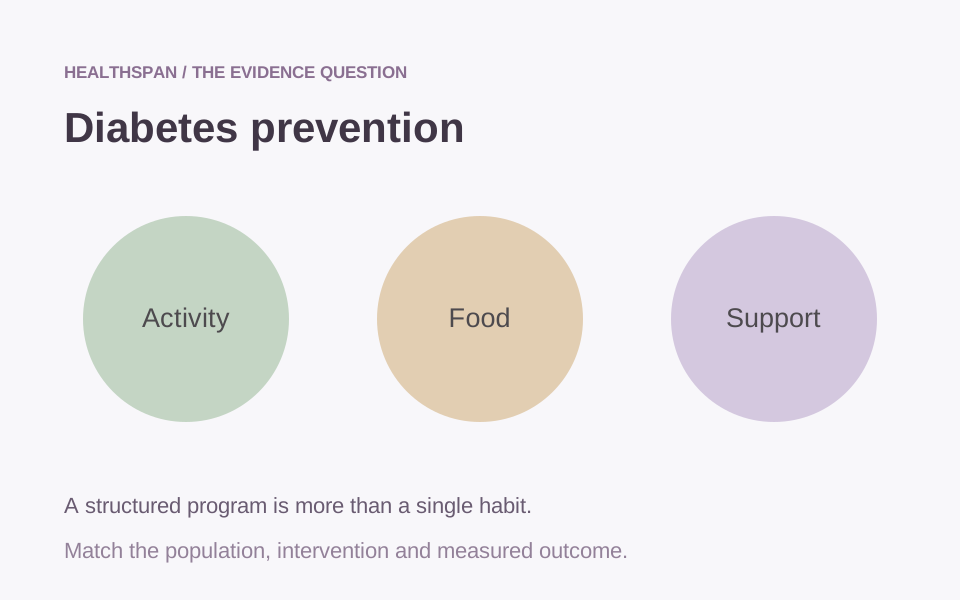
- Its lifestyle intervention combined goals with organized support.
- Fewer diagnoses, weight change and app engagement are different endpoints.
Prevention needs a defined starting point
A diabetes-prevention claim should identify both who was studied and what counted as prevention. The US Diabetes Prevention Program, or DPP, studied people with elevated fasting and post-load glucose who did not already have diabetes. Its result therefore concerns delaying or preventing a new diagnosis in a higher-risk group. It does not mean that any person who follows a diet has the same expected benefit, or that an established diagnosis can be reversed by downloading a tracker. The eligibility criteria are part of the finding. [1]
This distinction matters when a modern service cites the DPP. A recognizable program name may refer to a behavioral curriculum, a commercial adaptation, an insurance benefit or the original randomized trial. Those are related but different things. Ask whether a service offers sustained coaching, a clear participation schedule and a way to review progress. An interface that records food may support that work, but recording a behavior and delivering the studied intervention are separate achievements.
For the limits of consumer glucose feedback, read CGM without diabetes: what a glucose trace can establish.
What the original US trial compared
The DPP randomly assigned 3,234 participants to placebo, metformin or an intensive lifestyle program. The lifestyle goals included at least 7% weight loss and at least 150 minutes of physical activity per week. Average follow-up was 2.8 years. Diabetes incidence was 11.0 cases per 100 person-years with placebo, 7.8 with metformin and 4.8 with lifestyle intervention. Relative to placebo, incidence was 58% lower with lifestyle intervention and 31% lower with metformin. These are randomized comparisons within the enrolled population, rather than outcomes among only the most enthusiastic program finishers. [1]
The 58% figure is a relative reduction in incidence, not a guarantee that 58 of every 100 people will avoid diabetes. It also should not be compared casually with a company’s percentage weight-loss claim. One statistic describes new diagnoses over follow-up; the other may describe a change in body weight among a selected group. Keeping the endpoint and denominator visible prevents a large research result from becoming a vague assertion that one service is more effective at improving health than another.
Finland provides an independent randomized test
The Finnish Diabetes Prevention Study enrolled 522 middle-aged, overweight adults with impaired glucose tolerance. Individualized counseling addressed weight, fat intake, fiber and physical activity. After four years, cumulative diabetes incidence was 11% in the intervention group and 23% in the control group; the trial reported a 58% relative reduction. Diagnoses were based on glucose testing with confirmation. This is an independent study supporting the underlying approach, rather than another report from the same US participants. [2]
The multicomponent design is useful in practice but limits ingredient-level claims. The trial did not isolate an eating window, a particular fiber supplement, a step counter or a protein product. It also cannot establish that a single target was necessary and sufficient for every participant. A program can be effective as a package even when its components interact. Conversely, a merchant cannot assume that including one recognizable component transfers the package’s clinical result to a different service.
To separate a single dietary tactic from a program, read Eating schedules and the evidence for time restriction.
Da Qing asks a longer-term question
The Da Qing study began with 577 adults with impaired glucose tolerance in 33 Chinese clinics. Clinics were assigned to control or one of three diet and exercise interventions delivered for six years. A later report followed the original groups for up to 30 years. The combined intervention group had a median delay in diabetes onset of about four years and fewer cardiovascular events and deaths. The long follow-up adds clinically important context, while retaining the limitations of following people long after the active program ended. [3]
Thirty-year follow-up does not mean participants received thirty years of the original coaching intervention. Subsequent care, habits and survival all form part of the later period. The report is valuable because it follows an originally randomized comparison into outcomes beyond the first diabetes diagnosis. It does not provide a personal life-expectancy calculator, nor does it establish that a present-day app will reproduce the same long-term result. Duration should describe both the intervention and the observation, rather than using one impressive number for both.
Evaluate a service by its actual delivery
A plausible implementation should make its support concrete. Look for who provides coaching, how sessions are delivered, the expected attendance, how missed sessions are handled and whether support continues after the initial phase. Ask how the provider confirms eligibility and how it communicates with existing clinical care. If medication is offered, evaluate that as a separate clinical decision and cost. The original comparison does not authorize a service to treat every reader as an appropriate candidate for a medicine.
Outcomes reporting deserves the same attention as the curriculum. Results among everyone who enrolled answer a different question from results among members who completed a minimum number of sessions or supplied follow-up weights. Neither denominator should be hidden. Also separate engagement measures from clinical outcomes: opening an app, attending sessions and reducing weight can be useful observations without being the same as fewer confirmed diabetes diagnoses. A purchase decision becomes clearer when the seller identifies precisely which result it actually measured.
For another supported activity intervention, read The LIFE trial and a concrete mobility outcome.
A useful plan can be more modest than a promise
A reader can use these studies to ask better questions without turning a research target into an individual prescription. Current glucose status, medications, mobility, nutritional needs and preferences may affect the appropriate plan. Someone already living with diabetes needs an assessment designed for that situation. Someone without the trial’s elevated-risk profile should not assume the published absolute benefit applies unchanged. The evidence supports structured prevention in appropriate populations; it does not require indiscriminate monitoring or a paid membership for every adult. [1] [2] [3]
When comparing programs, write down what the fee buys: sessions, messaging, record review, maintenance support and any separate testing or clinical services. Decide whether the schedule is realistic and whether the information can be shared with the clinician already involved. A practical program is one a person can attend and adapt with appropriate support. The lasting lesson of these trials is that sustained, organized help can change a clinical outcome. A sophisticated dashboard earns its place only when it helps deliver that work.
Sources
Research describes groups and specific study conditions. Your medical history, symptoms and treatment decisions require advice from your own qualified clinician.