In this article
What to know
- Compare creatine plus training with the same training plus placebo.
- A lean-mass result does not establish a bone or disability benefit.
- Dose, timing and participants vary; preserve the null trials.
The useful question is the added benefit
Creatine can add to some resistance-training outcomes in aging adults, but the size and consistency of that addition vary across studies. A stronger lift is not automatically a reduction in disability, and a larger lean-mass estimate is not automatically more contractile muscle. The informative comparison gives both groups the same exercise opportunity and asks what the supplement contributes beyond it.
This distinction also makes the evidence useful to a buyer. The choice is not between a powder and doing nothing; it is often between investing in a training routine, adding a supplement to that routine, or both. A trial that supplied scheduled exercise does not establish the same result for someone who buys creatine but never begins training. The intervention needs to be understood as it was actually delivered.
The training intervention deserves its own assessment in the older-adult strength-training evidence.
A small trial with a clear daily dose
Aguiar and colleagues randomized 18 healthy older women, average age about 65, to creatine or placebo, nine per group. Both groups trained three days weekly for 12 weeks; the creatine group took 5 grams daily. The investigators reported greater strength improvements, fat-free and muscle-mass gains, and performance on submaximal-strength tasks with creatine. Body weight and body-fat percentage did not change significantly within either group. [1]
The small denominator is crucial. Nine people in an arm cannot establish how reliably the result will carry over to a much broader population. Nor does it provide a strong estimate of uncommon harms. The trial supports a specific exercise-plus-supplement question; it is not a license to promise that every older adult will gain muscle or independence from that dose. A functional test in a short study also differs from observing disability over years.
A longer study separated timing from strength
Candow and colleagues studied 39 adults aged 50 to 71 for 32 weeks, assigning 15 to creatine before training, 12 to creatine after training and 12 to placebo. Creatine was 0.1 gram per kilogram around the training session, with matching placebo given on the opposite side of the session. Mean leg-press gains were 36.6 kilograms before, 40.8 after and 5.6 with placebo; corresponding chest-press gains were 15.2, 15.7 and 1.9 kilograms. Both creatine arrangements improved strength relative to placebo, without establishing a strength advantage for one timing. [2]
Those are changes on the tests used, not estimates of how much heavier a grocery bag a reader will carry safely. They suggest the timing debate should not overwhelm the more important question of maintaining the exercise routine. A result favoring one timing on lean tissue would not automatically establish the same hierarchy for strength, function or long-term health. Each outcome needs its own comparison.
Another protocol did not add a detectable benefit
A separate randomized trial in 20 men aged 55 to 70 tested 12 weeks of resistance training three days weekly. Sessions used three sets of ten repetitions at 75% of one-repetition maximum. Creatine involved 20 grams daily for seven loading days, then 0.1 gram per kilogram on training days, taken within an hour after exercise. The comparison group received carbohydrate placebo. This study did not find that post-exercise creatine enhanced the training adaptations. [3]
A null result under this regimen should be retained beside favorable studies, rather than explained away because the ingredient is popular. Small trials can give imprecise estimates, and different participants and protocols can produce different answers. The combined lesson is restrained: a potential added benefit is worth evaluating, while guaranteed gains and an exact universal timing rule go beyond these comparisons.
Muscle and bone did not move together
Gualano and colleagues used a 24-week trial in vulnerable older women with creatine, training, their combination and placebo conditions. The combined group gained 19.9% on leg press versus 15% with training plus placebo; that particular between-group difference was not significant. The combination improved bench press and appendicular lean mass, while bone mass and biochemical bone markers did not differ significantly across groups. [4]
This is why a statement about stronger muscles cannot be quietly expanded into a statement about stronger bones. Likewise, the best-looking percentage in a study is not necessarily the comparison that answers whether the supplement added value. Look for the direct difference against the same training with placebo, not simply change from the supplemented group's own baseline.
Match the purchase to the outcome
These trials do not establish a longevity effect, and small short-term studies cannot settle safety in every medical situation. The accessible reports also differ in the completeness of adherence and adverse-event reporting. Absence of a highlighted harm is not evidence that no harms occurred. A person with a relevant health condition, pregnancy or an existing treatment plan needs a suitability discussion rather than a dose copied from a study summary.
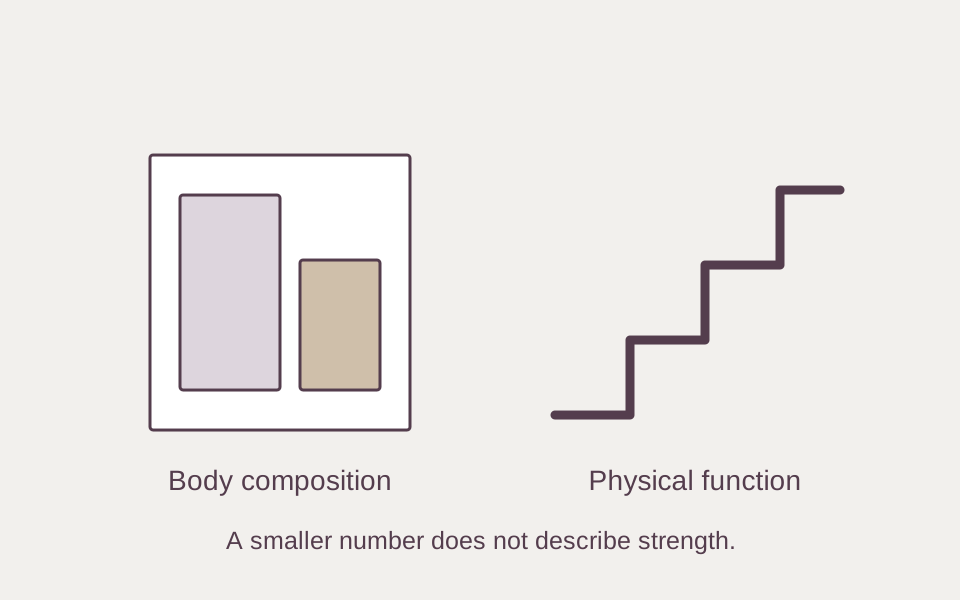
For an everyday decision, make the training plan concrete first and choose a simple product only if supplementation fits that plan. Keep track of performance, tolerance and the tasks that matter to you. If progress is measured by a smart scale alone, you may miss the distinction between a changing body-composition estimate and a useful gain in function. The strongest evidence question remains what the supplement adds to training you can actually sustain.
For a single-ingredient product and its purchasing tradeoffs, see Thorne Creatine.
Sources
- Aguiar et al. (2013): creatine with resistance training in older women (opens in a new tab)
- Candow et al. (2015): strategic creatine supplementation in older adults (opens in a new tab)
- Cooke et al. (2014): post-exercise creatine in middle-to-older men (opens in a new tab)
- Gualano et al. (2014): vulnerable older women, creatine and training (opens in a new tab)
Research describes groups and specific study conditions. Your medical history, symptoms and treatment decisions require advice from your own qualified clinician.